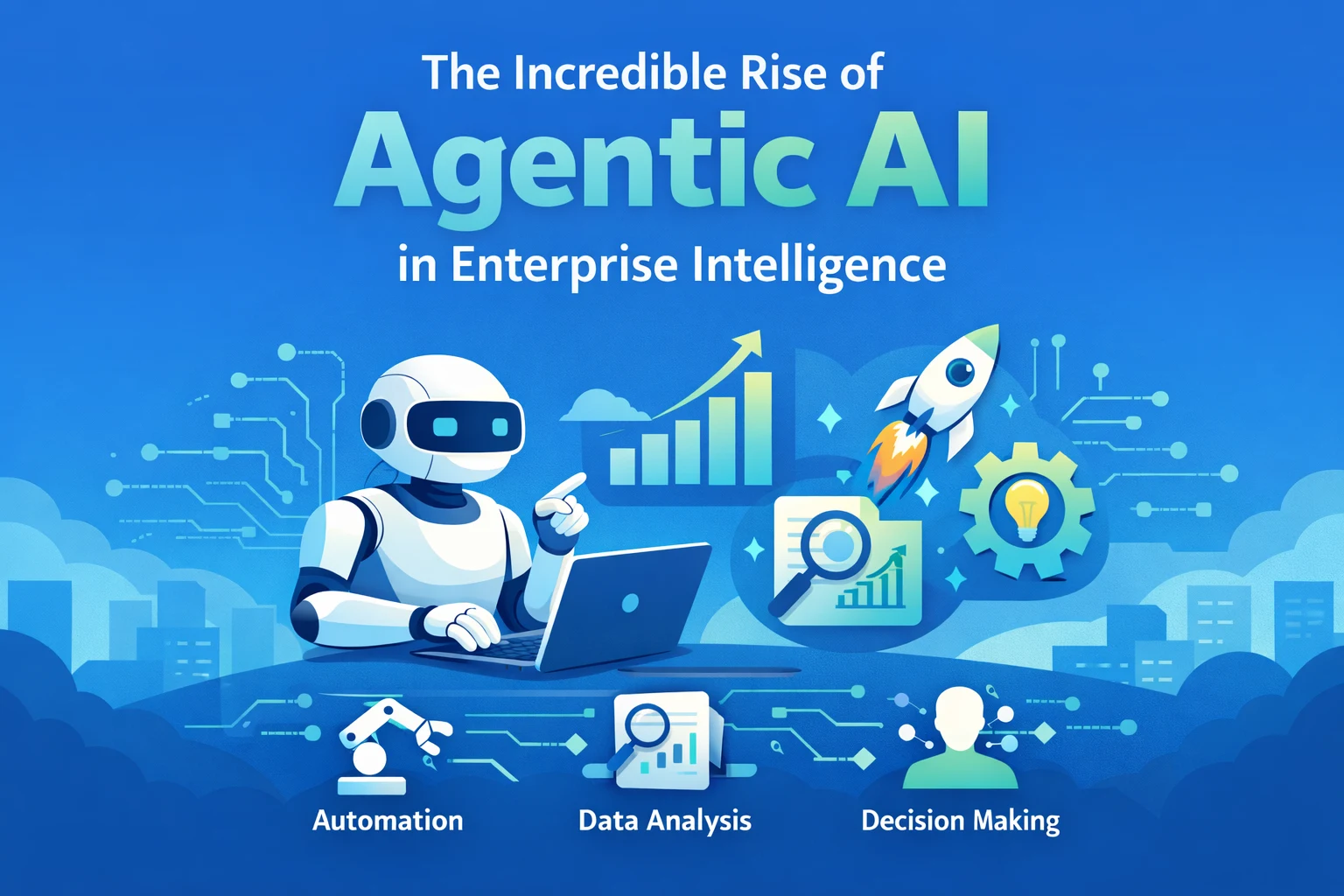
Artificial intelligence (AI) is used in businesses today to assist with numerous tasks. Traditional AI tools can help with answering questions asked by customers as well as interpreting data, but humans have to tell them what to do. That is beginning to change. A new wave of AI called agentic AI, along with multiagent systems, is helping computers not only think, but plan and act with less human guidance. This change is creating a new future for enterprise intelligence, where machines help run real business work automatically, reliably, and at scale.
What Is Agentic AI and Why It Matters
Agentic AI is a kind of artificial intelligence that does a lot more than just answer questions or give ideas. The old kind of intelligence like some chatbots or things that recommend stuff waits for people to tell it what to do and then it does it. But Agentic AI is different: it can pick what it wants to do and figure out how to do it. Then do it all by itself. As time goes on, Agentic AI can learn what works well and get better at doing things. This makes Agentic AI a lot stronger than the artificial intelligence systems. It is really good at learning and getting better over time which makes it very useful.
As an example, instead of simply writing up a report when a human requests it, an agentic AI system may:
- Choose the data required to make the report.
- Collect and clean that data.
- Generate insights.
- Send the report in automation.
By doing so, agentic AI will become more of a team member, rather than a tool.
The Power of Multiple AI Agents
Agentic AI is really good when lots of agents team up. This is what we call a multiagent system . Imagine you have one AI that tries to do everything by itself. It is different. It uses artificial intelligence agents and each one is good at something specific. These AI agents talk to each other. Work together to solve hard problems. They can do it faster and better than one AI agent working alone. The multiagent system is great because the AI agents can share what they know and help each other out.
That is how that is done in business:
- One of the agents collects information, such as sales data in several regions.
- One more agent is trend analysis and prediction of demand.
- A third agent may then update dashboards, report to managers or provide alarms.
Sharing the work makes the work much faster and is similar to the way human teams are organized, with each character doing what they excel at. This increases the speed, reliability and adaptability of the entire system.
Slowdowns can also be avoided by multiagent systems. When there is a problem with one of the agents, the other agents could continue with their jobs. This comes in handy particularly in large companies where the systems are complex and numerous processes rely on each other. Due to this, business is conducted in a much smoother way, more flexible, and able to respond to change within a shorter time.
Why This Matters for Businesses
Companies nowadays have to deal with a lot of information. They have to make decisions quickly. The old way of automating things can help with tasks but it usually needs a person to watch over it all the time. Agentic AI is different.
Boosting Efficiency
Agentic systems can take care of workflows. They can do things like look at data. Then take the next action. They can do all of this without someone needing to watch over every step. This means that teams can focus on thinking about the picture and what they want to achieve. Meanwhile the AI can handle the day to day operations of the systems.
Improving Decision-Making
Such systems integrate with business tools, business data and workflow. They are able to initiate activities when they observe new insights as they are happening. As an example, when it becomes apparent that one of the campaigns is losing traction, an agent can automatically change the targeting.
Simplified Expanding of the Business.
Rather than various autonomous tools, agentic AI is a digital coworker. It is able to support multi processes across various departments and platforms which operate seamlessly to the end.
This change promotes an organization to silo-bust and operate in a more efficient way. It also allows them to react fast in fast evolving markets, which provides early adopters with an advantage.
Challenges and Realities
Although autonomous enterprise AI is an exciting idea, it also presents real-life problems that enterprises must understand.
Not Every AI Project Works Out
Studies indicate that most early AI projects fail to get past testing. This usually occurs due to the complexity of projects, improper planning or lack of clear linkages to actual business requirements. Even an advanced AI may not add value without a definite reason.
Safety, Trust, and Control
Safety is very crucial when the AI systems are given more freedom to operate. The businesses should ensure that these systems are easy to understand and explain so that one can understand why certain decisions were taken. This assists in creating trust, adhering to ethical standards, and regulations.
Preparing the Workforce
Application of agentic AI is not a mere technology improvement, but it requires process, rule, and skill reorganization. The employees are to be educated to operate with AI systems and lead them. The concept of agentic AI is not to replace people, but rather aid them and teams to do more together.
What’s Next? The Future of Enterprise Intelligence
With the continued advancement of this technology, the manner in which firms operate will also shift. Businesses will not rely on AI as a helper rather see AI as a real team member capable of planning, making decisions, and taking actions independently.
This transformation will impact all aspects of a company including serving customers and supply chain management. It is not aimed at substitute people, but at eliminating repetitive, slow or cumbersome background processes. That allows employees to think more creatively, strategically and leadership.
Most business leaders consider agentic AI as a logical further step of generative AI. It is not just text or ideas creation but makes decisions and works. In such a future, AI will not only chat in such a future, but it will also perform tasks.
Frequently Asked Questions
What is the distinction between Agentic AI and traditional AI?
Classical AI generally answers the questions or helps people upon request. The next step is agentic AI, which is able to establish its objectives, plan, take action alone and learn based on the outcome.
Are agentic AI systems safe?
In fact, the AI agents can be safely run in case they are created and managed appropriately. Singular businesses need to be transparent, create effective regulations and human control to make sure that the agents are responsible and within acceptable limits.
Will this replace human workers?
Not completely. AI is used on repetitive or routine jobs and this means that human beings are able to concentrate on creativity, strategic and high-value jobs.
Can small businesses use agentic AI?
Absolutely. With tools being cheaper and easier to adopt, even small businesses can begin with certain tasks, such as automation of customer support to realize instant gains.